|
|
 |
|

Here are a few pictures of old American coins that I've found so far, and a little bit of history. I hope to find more
to add to this page. So check back every now and then to see if there is something new. Thank you.
|
|
|
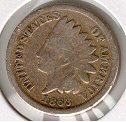
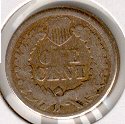
The above coin is an 1863 Indian Head cent, front and back view. It is probably the most famous of all the U.S. coins, the
only other to come close was the Morgan dollar. It was produced for 50 years without hardly a change in its design. It was
designed by James Longacre.
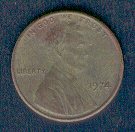
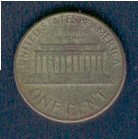
The above coin, front and back view, is a 1974 Lincoln Memorial cent. As you can see, the reverse was changed on the cent
from the Wheat to the Lincoln Memorial.
|
|
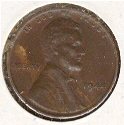
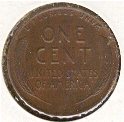
The above coin is a 1944 Lincoln Wheat one cent, front and back view. It is commonly called a wheat penny or a wheatie. The
Indian Head design would have continued if not for President Roosevelt hadn't pressed for its removal in 1909. It was the
100th anniversary of Abraham Lincoln's birthday. President Roosevelt wanted to memorialize the anniversary by placing Lincoln
on the penny. Lincoln's profile has survived the longest on a coin, unchanged. The coin was designed by Victor D. Brenner.
In 1959, on the 150th anniversary of Lincoln's birthday, the reverse was redesigned. The Lincoln Memorial was placed on the
back. It was the first time in history that the same President was displayed on both sides of the same coin. The reverse was
designed by Frank Gasparro.
|
|
|
|
|
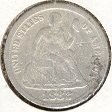
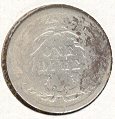
The above coin, front and back view, is an 1882 Liberty Seated dime. The designer of the coin was Christian Gobrecht.
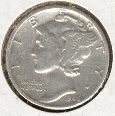
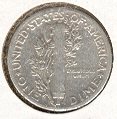
The above coin, front and back view, is a 1945 Liberty dime. When the coin was first issued, people saw the wings on the head
and thought it was a representation of Mercury, the messenger of the gods. Thus the people of the time started calling it
a Mercury dime. The coin was designed by Adolph Weinman.
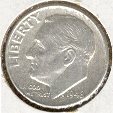
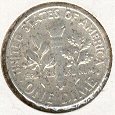
The above coin, front and back view, is a 1948 Roosevelt dime. When President Roosevelt died in 1945, the public wanted his
likeness to be placed on a coin. The penny, nickle, and quarter were dismissed because they already carried the likeness of
presidents on them. No dollars were being struck that year. This left the dime and half dollar, both having images of Liberty
on them. The dime was chosen, because it was more widely circulated. The designer of the coin was John Sinnock.
SINNOCK/BURKE INFORMATION
|
|
|
|
|
|
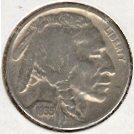
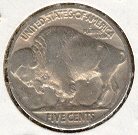
The above coin, front and back view, is a 1935 Indian Head five cent coin, but it was commonly called a Buffalo nickel. It
carries the true likeness of a Native American. The coin was designed by James E. Fraser.
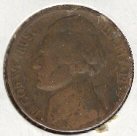
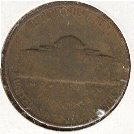
The above coin is a 1939 Jefferson 5 cent, front and back view. Jefferson was the third president to be placed on a coin.
When it was decided that Jeffersons' image was to be used in 1938, a public competition was was used to select the best design
and the winner also recieved a $1000.00 award. There were 390 entries, the winner was Felix Schlag. Jeffersons' home, Monticello
is shown on the back.
|
|
|
|
Footnote.....Dimes, quarter dollars, half dollars, and dollars that are dated 1964 or earlier are composed of 90% silver and
10% copper. This makes them a little bit more valuable, usually four times there face value. Some coins however, were minted
in lesser quantities certain years. This gives them a value ten times there face value. Lets not forget coin grading, the
better condition a coin is in when you find one, may increases its value.
Footnote 2.....Jefferson 5 cent coins dated 1942 to 1945 contain a small amount of silver in them. This was during World War
2, because the nickel was needed for military production, this caused a shortage for coin production, 35% silver was added
to continue coin production. The mint mark is above the building on the back of the coin. This is how you can tell it is a
wartime silver nickel.
Footnote 3....Our coins haven't changed much in design in the last 50 to 75 years, excluding the 50 States Quarter Dollar
Program. Before that time our coins were freqently redesigned, giving us a wide variety of art. That's what makes finding
an old coin fun. You get to experience art and a part of history.
Footnote 4....Over the years, our coins have developed nicknames. The 1 cent is called a penny, this is a carry over from
the British/Colonial days when British money was still used. The 5 cent, we call it a nickel, which is what part of the coin
is made of. The quarter dollar, I've heard it called two bits. It is a carry over from British/Colonial times when they used
the Spanish reale, which would have been cut literally into 8 pieces called bits, or pieces of eight as it was sometimes called,
to make change. "Two bits" make a quarter.
|
|
|
|